
In my design classroom there is a tension between structure and spontaneity. For the most part, students are working on individual and unique projects. I often joke that my job is actually "project manager for teenagers" as many of the soft skills I teach, model, and practice with students are related to breaking down complex long projects into manageable chunks for teenagers. And for many they would struggle to complete work without this structure. At the same time, we need to celebrate and engage with diversions, interruptions, and setbacks, and inspiration and acts of insight as these lie at the core of creative and critical thinking.
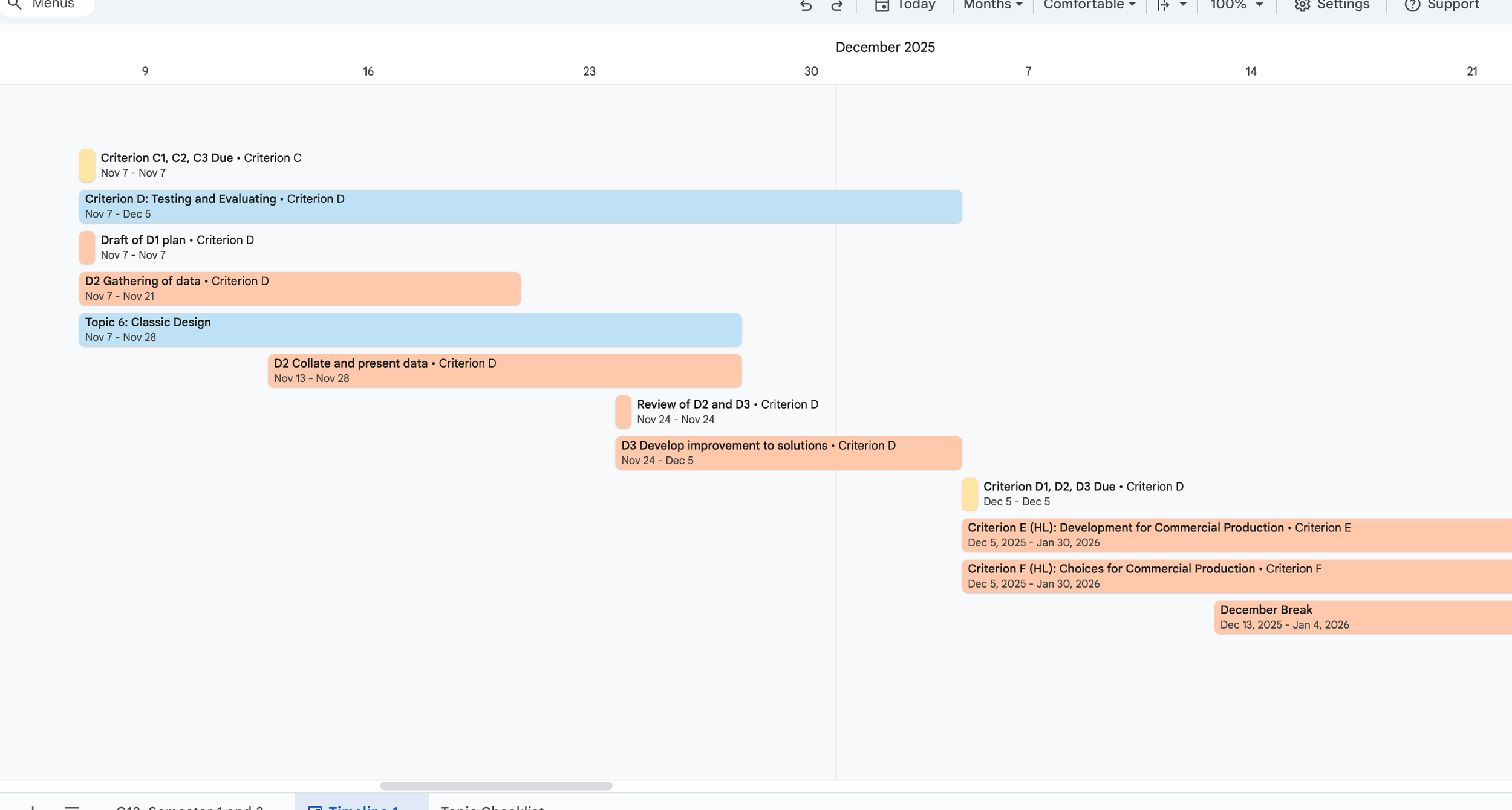
Gantt Chart in Google Sheets for a design project.
To manage this balance, I use a few strategies:
Discuss what time management is: Most will assume it refers to finishing a project on time. But it is really about the steps along the way to completion. Students staying up to 4am to finish a design project that they have put off until the last mint is not good time management. Ongoing discussion and conferencing on progress is key - don’t assume students know how to manage their time, or understand what it is.
Over-communicate the schedule or timeline: Each class starts and ends with a check in on the process with due dates. The sense of where we are in the process must be clear in every lesson.
Provide agency for planning within a structure: I often provide a partially completed timeline with key dates; I then guide students through reflecting on what interruptions, summative assessments, trips or events, that will "interrupt" this project. Together we co-plan the steps and stages of the project.
Celebrate good time management: Sometimes students will "work ahead" in design class in order to finish a project early so they can direct their attention to other subjects. They are prioritizing! We celebrate this, and highlight it as good time management.
Be explicit and realistic about extensions: We have a department policy about extensions that is proactive. We encourage students to ask ahead of time (very few actually do). We also discuss what is an appropriate amount of time as often students will give an unrealistic estimate of time. Taking a moment to learn about the nature of the request is important for building trust and a healthy working relationship.
These structures help us then incorporate the spontaneity that is also so important to our discipline. We can take diversions, but quickly turn back to the plan. We can consider new ideas or actions and revise the plan to make them happen. And when unexpected delays happen, we have a framework within which to take steps to refocus or adjust our goals. Modeling flexibility to these unexpected turns builds trust. Having these elements as part of the “holding environment” of the classroom helps to create safe, collaborative, and dynamic learning environment.
Some tools we use:
Kanban Boards: I’m biased towards the public display of progress as this helps reinforce pace; I’ve tried digital versions, but find that while they work at the individual level for a motivated student, they are not always the best in a classroom context. Visible, public displays of steps and progress help in this areas.
Gantt Charts: Great for outlining the steps, components, and interruptions that will take place over the course of the term or project. Google Slides now makes it easy to create timelines.